
Michael
-
Posts
828 -
Joined
-
Last visited
-
Days Won
9
Content Type
Profiles
Forums
Blogs
Events
Gallery
Downloads
Store
Everything posted by Michael
-
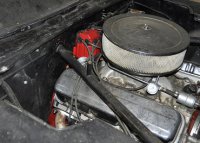
Does anyone have any particular preferences for electric cooling fans? I'm using a Griffin aluminum 2-core radiator, 27 1/2" by 19" (it fits when angled forward, and when the stock Datsun sheet metal crossmember connecting the inner fender is cut out), and I'm trying to cool a 350 hp 454" big block. With the angled radiator, a pulley-driven fan is not practical. Also, I'm sure that people have noticed the claims that while pulley driven fans may absorb on the order of 10 hp, electric fans supposedly draw less than 1 hp max (1 hp at 12 volts = ~60 amps!). Granted, the blades of electric fans are more efficient, electric motors are about twice more efficient than internal combustion engines, and there are fewer parasitic losses (rotational inertia of fan clutch, friction of pulley belt, etc.). But we're talking orders of magnitude here! I just don't see how the numbers stack up. Any ideas???
-
Running into tubing problems....
Michael replied to a topic in Brakes, Wheels, Suspension and Chassis
I'm no welding expert, but I'm working with a guy that is. He definitely recommends mild steel instead of chromoly for anything short of a pro race car. The Chassis Shop guy might be a pompous twit, but basically, he has a point. Chromoly steel tends to brittle. The heating and (cooling down) inherent in the welding process tends to exacerbate the natural brittleness of the material, and may cause the formation of local microscale imperfections. These are the weak links in the chain. The result will still be strong in continuously applied loads, but if you whack the welded are with a hammer (or crash the car!), it might crack at a lower load intensity than the corresponding mild steel structure. Your estimate of 125 lbs for the roll cage weight sounds about right, if you're building a full cage. With chromoly, you will save about 50 lbs. So, we can invoke the usual statement that it's easier and cheaper to add a little more power to the engine than to try to shave off the last bit of weight off the car. If you have your heart set on chromoly, it might be worthwhile to first visit a local welding shop and talk to the pros. "Chassis Shop" has a good deal on chromoly, but NOT on mild steel DOM tubing. You will have better luck at a local supplier. -
Suspension....What do you run?
Michael replied to Mikelly's topic in Brakes, Wheels, Suspension and Chassis
It's great that we're addressing handling issues for a car that's supposed to be "all straight line"!!! I have a question for the cognoscenti: why are V8 Z cars reputed to understeer? Of course, this is a rather complex issue. But stripping it down to the essential details, nose heavy cars will tend to understeer, but tail heavy cars will oversteer. Things change if the rear tires are much stickier than the front, if the front suspension has different camber gain than the rear, if one end has a stiffer roll bar than the other, etc., etc. But in general, I'd intuitively expect a V8 Z with lots of engine "set back" to oversteer (and I don't mean torque-induced oversteer - that's a no brainer). My car, with all that sheet metal relocation, has the crank pulley just over the steering rack, and the harmonic damper behind the front crossmember - and this is with a big block. With a hardcore (heavy!)roll cage, I expect a weight distribution of 45/55 (tail heavy). The other issue that I wanted to discuss is that of lowering the car but keeping the engine fairly "high" under the hood, or lowering the engine with respect to the car, but keeping the car at essentially stock height. My oil pan is 9" deep, and I'm using a Lakewood bellhousing. It's a huge piece that really hampers ground clearance. Since I'm mounting the engine to the frame rails, and not to the crossmember, engine mount geometry is something to worry about. I wonder how low people have been setting their cars; for instance, what is the distance from the ground to the bottom of the frame rails under the floor pans, or from the ground to the steering crossmember? -
Though I've annoyed some people by saying this, I really think that moderate performance cars don't really benefit from roll cages etc. My guess is that your stock 305 conservatively makes about 160 hp and 220 ft-lbs of torque, in real-world numbers. A more precise estimate would depend on the head casting (and valve size, and many other things). With a decent dual-plane intake manifold, four-barrel carb, 1 5/8" block hugger headers, mild cam and a little tuning, plan on about 220-250 hp and maybe 280 ft-lbs of torque. If that feels like too little, consider that my '78 454 big block, with 149 more cubic inches and a much better head design, only makes 215 hp stock, because in stock form it signs off at around 4000 rpm, if that much. My admittedly unexperienced opinion is that it's better to do the conversion with the stock engine, and then hop the engine up, once the car is running and you've comfortable with the setup.
-
Torque tubes & Cages...
Michael replied to Mikelly's topic in Brakes, Wheels, Suspension and Chassis
As far as I know, NHRA indeed requires 0.120" thick DOM mild steel tubing. Chromoly, if you choose to use that, only has to be something like 0.83". Oddly enough, the industry standard for mild steel is 0.118" ! And that apparently won't pass tech. So what I did was reluctantly follow my hot rodding mentor's advice, and went for the 0.134" tubes - these are the next thickest size. In 1 5/8" diameter, these are kinda beefy. I figure the whole cage will weight at least 100 lbs, maybe 150. That's with diagonally crossed "door bars" (really more to connect the dash-area bars to the B-pillar bars, than to protect the driver in a crash) and a system that ties into all four strut towers. We just bent the big hoop that goes behind the drivers head (the "roll bar", I suppose). We got it to fit just ahead of the roof pillar supporting the hatch hinges, and right against the headliner. -
Wow, this thread grew quickly.... Anyway, let's first mention an obvious but important thing about the stock rear end - make sure it's an R200, not an R180. If you have a 70-74 240/260 or automatic 280, you're saddled with an R180 - but it's a bolt-in swap for the R200. I had to do it with my car parked next to the curb on the street (no garage, sadly). Regarding costs of a 4-link and Ford 9" combo.... I was quoted $5000 for parts and labor, from a very competatively priced one-man shop. Basically, you have to "back half" the car. That means not only work on the body and subframe, but also on the rear axle (shortening the housing, custom axles, etc. - and maybe even custom brakes). On the other hand, getting parts for the Ford 9" vs. the Datsun unit is like getting parts for the Chevy SB vs. the L28; cheaper, stronger, far better selection. Alternatively, you could retain the independent rear suspension and install either a Ford 9" center section with custom halfshafts, or use shortened Oldsmobile Toronado halfshafts, or even an Olds Toronado center section. This is not a common swap, but some chassis gurus (such as Herb Adams) claim that the Olds swap is cleaner and stronger than the Jag or Corvette. But I've never heard of it done to a Z.
-
XtrmSpeedFrk, I saw a car like what you describe at a "Super Chevy " show a few years ago, except that he had a 406 (on nitrous) and a Powerglide. It seems that hard core drag racers prefer the powerglide automatics. The guy ran mid 9's, with all-steel body (except for fiberglass hood), subframe connectors, minimal roll cage, and Ford 9" rear hung off a 4-link. I'd venture to say that the hardest part of your project - by far - will be changing the rear suspension. That's a lot of custom work, and its not covered in the various V8 Z conversion literature. Nevertheless, NHRA rules apparently state that you can't run faster than 11.00 with an independent rear axle. Perhaps you'll write a tech article on the subject when you're done???
-
For the folks that have experience with broken half shafts.... What exactly happens? Do you hear a crack and a thud, and that's it, or does the loose half shaft rip apart sheet metal and hydraulic lines as it spins? The point is, I'd rather see for myself if the stock R200 half shafts are strong enough, rather than complicating my already huge project by an upgrade to pre-empt a possibly minor failure - if indeed the failure is "minor".
-
Torque tubes & Cages...
Michael replied to Mikelly's topic in Brakes, Wheels, Suspension and Chassis
At the risk of ruffling some feathers, I'd have to say that a bolt-in pre-fab cage is not a good idea. That's especially true for Z's since NO MAINSTREAM HOT-ROD MANUFACTURER makes an NHRA-approved "kit" for the Z. If you call Morrison, S&W, Magnum Force, Steve Alston, whatever, they will sell you a generic package of tubes designed for a Vega or Pinto. They don't fit well, and they are plagued with unbraced bends in the tubes (prone to buckling). A real cage is A LOT of work. You end up stripping out the entire interior, the carpets, plastic body panels, everything. You clamp the unibody to a rigid chassis jig, so that the thermal stresses from welding don't cause displacements in the metal. Then you have to worry about where to anchor the tube ends. Sheetmetal? Forget it. You need reinforcing sub-structure underneath the cage. For maximum benefit, you need to weld a network of gussets to secure the cage to the room, B-pillars, etc. And you will end up with diagonal members barring the door openings and criss-crossing the car. IMHO, if this is not what you want, don't build a cage. (My appologies if I'm starting to sound like Mark Sayer )A hoop behind the driver's head might save your life if a tractor trailer rolls over the rear hatch, but it won't do much for the structural integrity of the car - especially for torsional stiffness. BUT - I've seen 11-second V8 Z's run at national drag racing events with simple roll bars and subframe connectors. We're not building 1200 hp pro mod dragsters here (and frankly, I think that these pro-mod dragsters are not very well braced either). If this is a budget V8 conversion, if you spent $500 of a Z shell and most of your money is going into the engine and drivetrain anyway, it makes more sense in the long term to just let that unibody twist and then discard it and to buy a new one. Building a cage becomes like paying more for insurance premiums than the cost of what you're trying to insure. -
Torque tubes & Cages...
Michael replied to Mikelly's topic in Brakes, Wheels, Suspension and Chassis
I'd be inclined to comment that a car with enough power and torque to appreciably cause structural problems with its unibody is already enough of a "race car" that we can no longer apply pure street-only concepts to it - regardless of whether you actually race it. Conversely, a car that is only driven in "street-type" situations probably would not benefit from a huge amount of torque, with the possible exception of rare and brief smile-inducing bursts that in themselves do not justify going to the effort of installing extensive structural mods. Probably your best bet would be simple strut tower braces. These can be home made with a drill, hammer, vice, and saw. Beyond that, consider subframe connectors, especially if you have a 240Z. I decided from the very start that I wanted a maximum effort drag car, and that drove my decisions on structural reinforcements as well. But perhaps people are too concerned with the example of those individuals who really do have full-effort race cars, and who really do need roll cages etc. Most V8 Z conversions would probably be fine with no cage and no braces of any kind. If I were doing the conversion alone and on a tight budget, I would not worry about structural mods, because the car that I could realisticly build would not need them. -
Folks, Regarding the balancer issue for stroker motors.... Back when I was interested in a small block, and when I was about to use the JTR setup, I wanted to get a 383 or 406 with 8" Balancer. Concerned about the steering rack clearance issue, I e-mailed Mike Knell of JTR. He said to either 1) get the crank internally balanced, or 2) get the smaller 6" balancer (just make sure it has the 400-crank counterweight). For those of you in the Los Angeles area, last year I ran into a guy at the Orange County Z club with a '73 240 Z with a 383 stroker. He had his crank balanced internally (with 5.7 350-type rods and stroker pistons). Also, have we entirely ruled out the possibility to move the motor yet further back, clearing the steering rack entirely? If you're willing to ditch the stock hood latch location entirely, and relocate the brake and clutch hydraulic lines, there's got to be another inch of setback room lurking back there....