Leaderboard

Popular Content
Showing content with the highest reputation on 11/10/26 in all areas
-
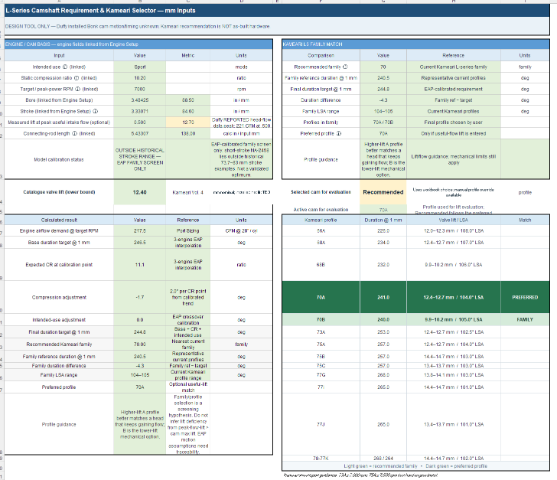
Hi Duffy, here's some more of the info I promised. Looking at your port size and flow numbers, I think your engine is pretty well suited to a 7,000 RPM power peak. Going with a much larger cam might shift the powerband higher without gaining much peak HP, especially given the head's airflow limitations. For a street-driven car, I'd favor average horsepower over chasing a higher RPM peak. I built my cam calculator around Kameari's range of cam profiles, with a dropdown for Street, Sport, Track, or Race to help determine the intended powerband. I originally had your engine set to Sport, which recommends the Kameari 70A at 241° @ 1 mm, or 232° @ .050" . Switching to Track changes the recommendation to the 73A at 253° @ 1 mm, or 244° @ .050". Your Bonk cam is 240° @ .050", putting it right between those two recommendations. So far, I'd say you made a pretty good cam choice. here is the cam recommendation tab in my calculator cam.pdf Next I'll show you the EAP simulated dyno curves for the different cams so you can see how they compare. I loaded all the engine parameters into my analysis program to compare the cams Here are the results. Of course some assumptions as usual, as I did not put the Bonk cam on my cam stand to actually measure its profile, so it is a educated guess where the Kameari cams are documented. As expected a little more top end a little less midrange but all in a good range for what you are building As a final note, in the calculator the simulation assumes ideal conditions, and these are engine numbers at the flywheel. so I would be very surprised to see these actual number, especially on a chassis dyno. What's important is the shape of the plot and getting the power where you want it and how you want it. This last one is my best guess of what your car should be around on a chassis dyno, 12% drivetrain loss and some reduction for real world conditions
 2 points
-
For round ports like ours, these do alright, find the smallest location, and then measure this telescoping gauge with calipers , But remember diameter is different than area. With the diameter you can calculate area with an easy online calculator if you forget how to do it.
1 point