
MONZTER
-
Posts
841 -
Joined
-
Last visited
-
Days Won
37
MONZTER's Achievements


-

Nissan L-Series Cylinder Head Flow Bench Testing and Development
MONZTER replied to MONZTER's topic in Nissan L6 Forum
I don't think so, it's going to be a wonderful street / track car. To make 300hpb you would have a good looking dyno graph and a pain in the ass car to drive. From the math, all your parts are really well matched to your head and it's purpose. When will it be running? Again, it's just a dyno simulation, so we will see -
Nissan L-Series Cylinder Head Flow Bench Testing and Development
MONZTER replied to MONZTER's topic in Nissan L6 Forum
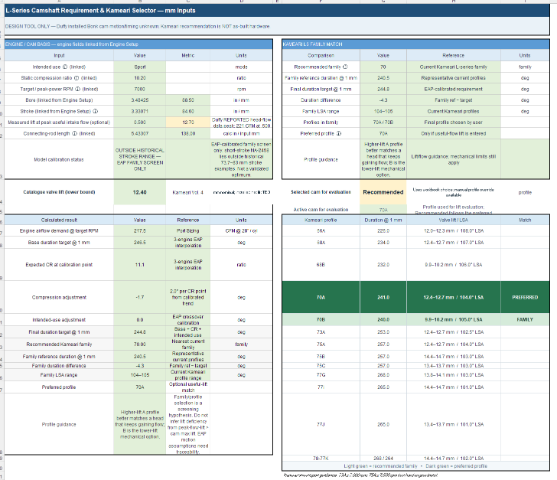
Hi Duffy, here's some more of the info I promised. Looking at your port size and flow numbers, I think your engine is pretty well suited to a 7,000 RPM power peak. Going with a much larger cam might shift the powerband higher without gaining much peak HP, especially given the head's airflow limitations. For a street-driven car, I'd favor average horsepower over chasing a higher RPM peak. I built my cam calculator around Kameari's range of cam profiles, with a dropdown for Street, Sport, Track, or Race to help determine the intended powerband. I originally had your engine set to Sport, which recommends the Kameari 70A at 241° @ 1 mm, or 232° @ .050" . Switching to Track changes the recommendation to the 73A at 253° @ 1 mm, or 244° @ .050". Your Bonk cam is 240° @ .050", putting it right between those two recommendations. So far, I'd say you made a pretty good cam choice. here is the cam recommendation tab in my calculator cam.pdf Next I'll show you the EAP simulated dyno curves for the different cams so you can see how they compare. I loaded all the engine parameters into my analysis program to compare the cams Here are the results. Of course some assumptions as usual, as I did not put the Bonk cam on my cam stand to actually measure its profile, so it is a educated guess where the Kameari cams are documented. As expected a little more top end a little less midrange but all in a good range for what you are building As a final note, in the calculator the simulation assumes ideal conditions, and these are engine numbers at the flywheel. so I would be very surprised to see these actual number, especially on a chassis dyno. What's important is the shape of the plot and getting the power where you want it and how you want it. This last one is my best guess of what your car should be around on a chassis dyno, 12% drivetrain loss and some reduction for real world conditions
-
Nissan L-Series Cylinder Head Flow Bench Testing and Development
MONZTER replied to MONZTER's topic in Nissan L6 Forum
For round ports like ours, these do alright, find the smallest location, and then measure this telescoping gauge with calipers , But remember diameter is different than area. With the diameter you can calculate area with an easy online calculator if you forget how to do it.
-
Nissan L-Series Cylinder Head Flow Bench Testing and Development
MONZTER replied to MONZTER's topic in Nissan L6 Forum
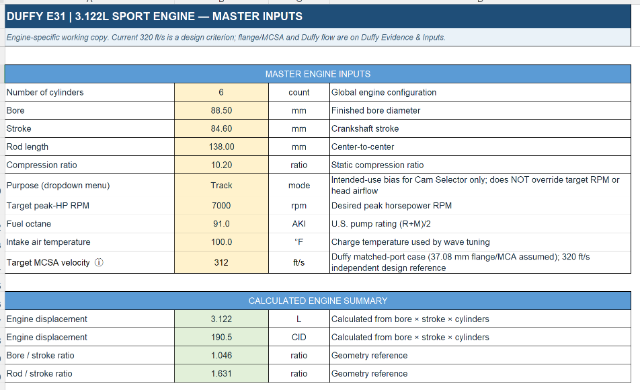
Duffy thanks, this lets me complete most of the analysis. Lets have a look at the basics first, I've adjusted details too better match your set up. I've also set it to track given your cam choice as it is better suited for higher RPM power and the resultant port sizing based on what you told me (Intake) Exhaust Intake Valve Exhaust valve Bowls so far all your specs align quite nicely with the workbook prediction for an optimal engine for trackish use with a 7000rpm peak power band. Ill get you runner length specs tomorrow and simulated dyno run numbers
-
Nissan L-Series Cylinder Head Flow Bench Testing and Development
MONZTER replied to MONZTER's topic in Nissan L6 Forum
Hi Duffy, I calculate it from seat to bell mouth end but I already know port length, so Intake runner length from Head flange to Throttle body. (I was guessing 110mm), TB Length of 88mm long, another guess, and 65mm velocity stacks a third guess, so it will be good to know exactly, thanks -
Nissan L-Series Cylinder Head Flow Bench Testing and Development
MONZTER replied to MONZTER's topic in Nissan L6 Forum
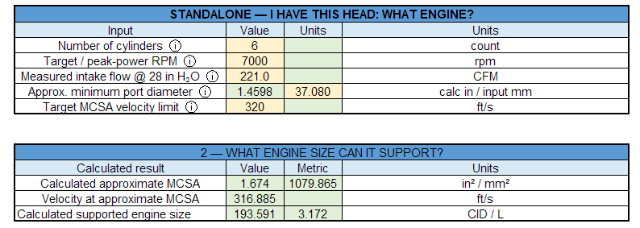
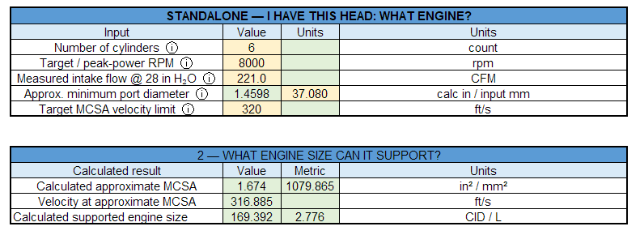
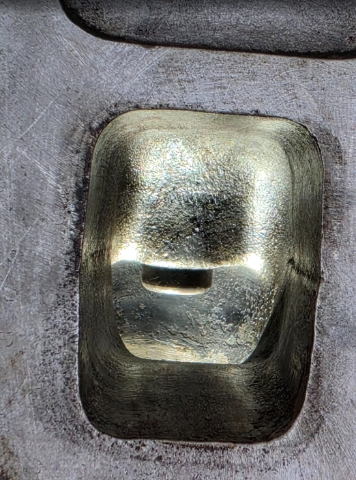
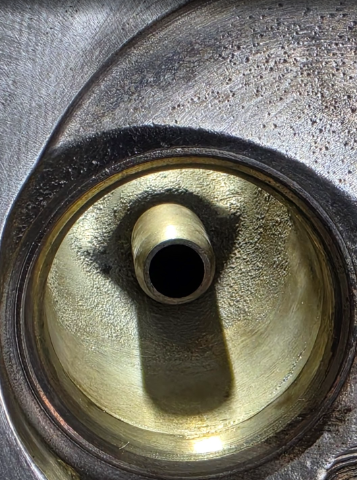
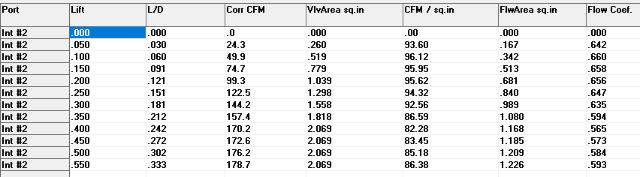
Duffy, that helps quite a bit. With the 37.08mm measurement being the equivalent diameter of your port opening, and that the flange is at or near the MCA, this changes my original calculations considerably. At 221 CFM, the calculated velocity through that opening drops from 356 ft/s with my original 35mm assumption to about 317 ft/s. That's almost exactly the 320 ft/s design target I was using for the L-series port. Using that new dimension, 221 CFM and a 7000 RPM peak horsepower target, my calculator comes up with a 3.172-liter engine. That's remarkably close to your actual 3.122L. So based on these assumptions, your displacement and intake port size appear to be pretty well matched for a 7000 RPM power peak. That's encouraging, especially considering your goal is a responsive street car rather than an 8000 RPM race engine. (At least what I think, for what its worth) I also did a rough port-volume calculation using your 45mm intake valve, an assumed 90% throat (40.5mm), an 8mm valve stem and the port centerline length from my E88 measurements. Assuming a gradual expansion from the flange toward the throat, I get approximately 124cc. That's only a geometric estimate, since we don't know the actual CSA progression or how Andy shaped the bowl and short side. We will use this number later to look at average port dimeter. What Andy is doing around that short-side turn is particularly interesting. If he's increasing the area and controlling the flow as it approaches the valve, that could help explain how he's getting those flow numbers without an excessively large flange opening / MCA. The one thing we still don't know is whether 37.08mm is actually the smallest section or whether the port necks down somewhere else. On L-series it is typically pretty close to the flange or about an inch in before the turn. But this new information makes your 221 CFM result much easier to reconcile with the port geometry and displacement, and it suggests your existing combination is reasonably close to the type of driving you described. The next step would be looking at your actual cam timing and intake runner length to see how well they're matched to that 7000 RPM target. We can do that in the rest of the tabs in my calculator Im working on But look when we put that head on a 2.8, A real ripper at 8k
-
Nissan L-Series Cylinder Head Flow Bench Testing and Development
MONZTER replied to MONZTER's topic in Nissan L6 Forum
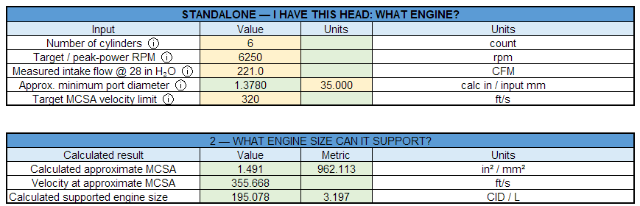
Duffy, thanks for the numbers. Let's see how this works out. My plan is to approach this two ways. First, "I have this cylinder head, what bottom end does it want?" Second, "I want to build this engine, what cylinder head do I need to support it?" Let's start with the first one. I've made a bunch of Excel calculators to help automate this process. Since I don't have all the details of your head, I'll need to make a few educated guesses. We have a 45mm intake valve and 221 CFM, which I'm treating as corrected to 28" H₂O. You mentioned roughly stock-sized ports, and this is where things get interesting. Flow numbers alone only tell part of the story. I'm going to assume a 7000 RPM peak horsepower target and a 35mm MCA (minimum cross-sectional area), expressed as an equivalent round diameter. The actual minimum might be at the flange or somewhere farther into the port. We won't know without measuring it. MCA is important because it determines the calculated average velocity through the smallest section of the port for a given airflow. For this example, I'm using 320 ft/s as a conservative flowbench-based design target. The L-series has a relatively low intake port with a sharp turn over the short-side radius. Picture a race car going around a track. You can carry plenty of speed down the straight, but enter a tight corner too fast and you're going to have problems making the turn. A modern high-port motorcycle head with a straighter approach to the valve might tolerate 350–360 ft/s. These are design guidelines, not hard limits. Port geometry and flow stability ultimately determine what's acceptable. Also, these are steady-flowbench-based calculations, not instantaneous velocities in a running engine. Dynamic sizing methods use piston demand and RPM and can produce considerably higher numbers. We've used approximately 613 ft/s as a dynamic design reference, but that's not a direct conversion from 320 ft/s. First example: 7000 RPM and 320 ft/s design target. The calculator gives us a 2.854-liter engine. Is that correct? Maybe, maybe not. It depends on what you're building. With our assumed 35mm MCA and a conservative 320 ft/s design target, the calculator suggests approximately 2.85L as a starting point for a 7000-RPM power peak. Notice the calculated velocity at MCA is 355.7 ft/s. That's based on the head's reported 221 CFM through our assumed 35mm minimum area. It's not a measured local velocity. The calculator is actually sizing this engine around approximately 199 CFM of required flow, corresponding to our 320 ft/s target. The head's full reported flow capacity remains 221 CFM. Now let's increase our design velocity target to 350 ft/s. Now we get a 3.122-liter engine. Same head, same assumed port size, same 221 CFM and the same 7000-RPM target. The difference is that we're allowing a higher calculated velocity at the engine's required airflow, approximately 217.5 CFM. But can this particular port support that demand efficiently? That's the question. If the airflow becomes unstable, especially around the short-side turn, cylinder filling may stop improving as RPM increases. This is where an engine can start running out of steam earlier than expected. A 3.1 or 3.2-liter engine needs more than a good peak CFM number if you expect it to keep making power at high RPM. The port needs the correct area, shape and flow characteristics to support that demand. OK, one more. Back to 320 ft/s, but lower peak horsepower RPM to 6250. Now we're at 3.197 liters. Nothing about the head changed. We're simply asking it to support peak horsepower at a lower RPM, where a larger engine can operate with less airflow demand per unit of time than it would at 7000 RPM. Here's how the three examples compare: The required-flow values come from the workbook's sizing model, not measurements of the running engine. Notice that 355.7 ft/s never changes. It's calculated from the same 221 CFM and 35mm MCA in every example. What changes is the engine's calculated airflow requirement at its target RPM. So what's my point? Flow numbers alone don't tell you how much power an engine will make or where it will make it. You need the right combination of airflow capacity, port area, displacement and RPM. None of these combinations is necessarily bad. They're just different engines that need different supporting components. A smaller displacement with a longer-duration cam might be happier running higher RPM. A larger displacement might make a better street engine, producing strong torque and reaching peak power sooner. Each would need its cam timing, intake runner length and exhaust system matched to the intended powerband. The mistake is assuming you can have everything simply by adding displacement, camshaft and RPM without considering airflow and velocity. This is why I think people need to be clear with their engine builder about what they actually want the engine to do, then select the components to support that goal. Getting back to your head, there's another important part of this. MCA is the smallest cross-sectional area anywhere along the port. Average CSA is calculated from port volume divided by centerline length. They're different measurements and tell us different things. Let's say your E31 has a 35mm MCA at the flange. At 221 CFM, that calculates to 356 ft/s. But if the port opens up to 37mm before the short-side turn, the calculated average velocity at that larger section drops to 318 ft/s. That's a significant difference on a low-port L-series head where the air has to make a sharp turn. This is why we need to know not only the MCA, but where it's located and how the port area changes toward the valve. Even with lower average velocity, poor short-side geometry can still cause flow separation. Port volume is useful too. For reference, a cleaned-up E88 measured approximately 104cc, a welded E88 measured 111cc, and the PAMS JP geometry calculates to approximately 129cc. These represent quite different port sizes, although volume alone doesn't tell us where the restrictions are. Ideally, I'd like to know your actual MCA, its location, and the intake port volume. With those measurements, we can make a much better assessment of what your head can support instead of guessing from peak CFM alone. And that gets us away from the bigger-is-better mentality and toward building an engine where all the components actually work together. Next, we'll look at the second approach: "I want to build this engine, what cylinder head do I need to support it?"
-
Nissan L-Series Cylinder Head Flow Bench Testing and Development
MONZTER replied to MONZTER's topic in Nissan L6 Forum
Duffy, If you want I will run your head in my calculators and Ill tell you what it shows. I need to know Target / peak HP RPM Measured Intake flow at 28" Approximate minimum port diameter, not necessarily the flange port opening This will tell me what engine capacity it will like If you tell me these specs Bore Stroke Rod Length Target / peak HP RPM I can tell you what flow it wants as well as the recommended minimum port diameter based on velocity Port velocity is just as important or more than flow, too much or too little is not always better -
Nissan L-Series Cylinder Head Flow Bench Testing and Development
MONZTER replied to MONZTER's topic in Nissan L6 Forum
Sorry, been busy as usual, I have tested my Welded N42 I ran on my 240 for years, I have also tested my PAMS head. Ill post the reports when I get a moment. Hopefully soon. My concern is that as some know and some do not. Flow and cfm do not tell the whole story. Port volume and thus port velocity along with a proper MCA for the actual displacement and peak HP RPM all combined with needed flow is the best answer, not just who flows more. So, Ill discuss this in detail as well so we can look at each head and its proper position on top of what engine. Its a lot to digest, so still thinking how to present it all. I also need to figure out how to get some decent resolution images to post with all the number legible. Thanks for the people who posted some numbers for referance. -
Nissan L-Series Cylinder Head Flow Bench Testing and Development
MONZTER replied to MONZTER's topic in Nissan L6 Forum
The first head to document will be an old E88 from my 72. I used this head a long time ago worth 40DCOE triple Webbers. In typical fashion long long ago I did my best to do what I thought was right. I blended the seats to match the bowls with a grinder, and port matched the head to the intake, opening up the port about 1" in from the entrance to blend the new opening (not good). other than that, stock valves and chambers So lets flow it. Hoping to borrow a stock E88 to compare later. Some pics for referance Here are the head Specs Cylinder 2 Intake with 84mm Bore And Cylinder #2 Exhaust with 84mm Bore I then switched out the bore to 86.5mm and tested again, here is a comparison chart of the effect of only a larger bore Sorry the image is hard to read I need to figure out how to upload better resolution pics, but you can download the PowerPoint below E88_Flow_Bench_Comparison_Cyl2_84mm_vs_86.5mm_FIXED (1).pptx
-
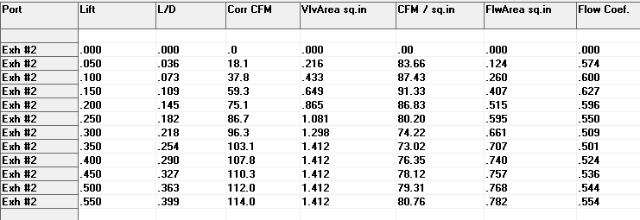
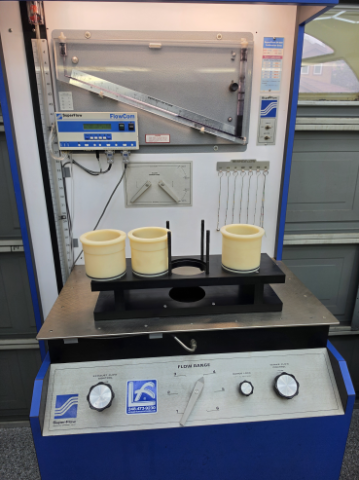
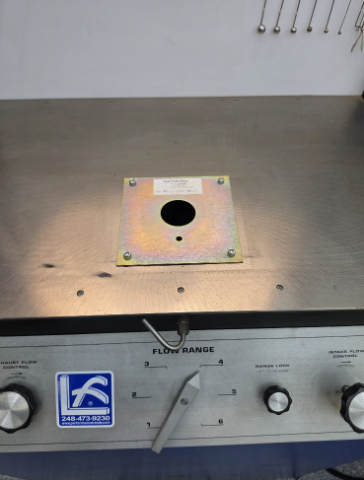
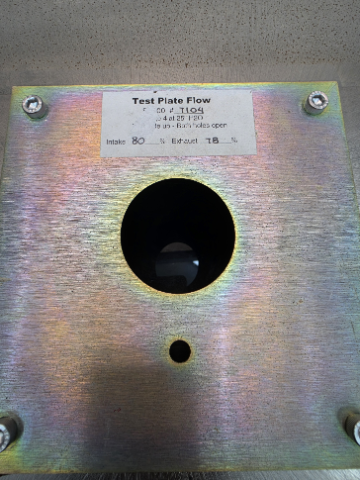
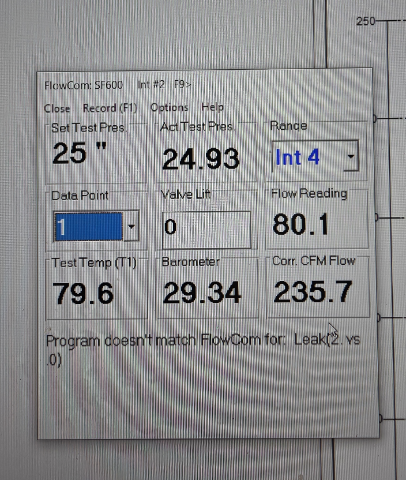
I've decided to build a detailed thread to document L-Series cylinder head flow testing and the results. Like many aspects of these engines, it's sometimes hard to know what to believe or how to interpret what you see and read. Test setup, equipment, testing methods, and just straight-up BS can all contribute to the confusion. I don't sell a product or service and have nothing to gain from the results I post, so my goal is to keep the testing unbiased and as consistent and repeatable as possible. Feel free to comment or criticize as I move through this. I'm happy for any input. First up is the equipment. I have a SuperFlow 600 converted to run the digital FlowCom directly to my laptop where I use PortFlow analyzer from Performance trends. This software sets up the test and aids in the data logging and reporting. It also compensates for Altitude, Barometric pressure, ect. So no math or reading of the old school manometers. Its super accurate and very repeatable. I built a L-Series specific test stand and replaceable cylinder bores to test the common sizes, 84mm - 240z , 86.5mm 280z, and 89mm - Big Bore. This has a considerable effect to the max flow due to bore shrouding, so its important to test on the correct size. This is the first place numbers can get "offset" If some guy is flow testing a Z head on his 4" Chevy bore, you bet the numbers will look good. More on this later. These bores are made of nylon and seal to the test stand with an o-ring. However any leakage can still occur, so the software takes a zero measurement first, and this leakage is then subtracted out automatically Next up is calibration - the bench should be calibrated on a regular basis to check for issues. You do this by bolting the supplied test plate that is matched to the machine and simply flowing it. Here you can see the plate bolted on, it has calibration flow percentages written on it to compare Ans this is the screen on the laptop, you can see the bench is within .1 percent calibration for the intake and exact for the exhaust Ill flow and document the heads I have as well as some I will borrow from friends. Some will be stock, some will be modified to various states. Ill also do some test to help point out important details. So stay tuned Thanks - monZter
-
All the Pop up ads make me hate being here, how to stop the madness
MONZTER replied to MONZTER's topic in Site Support
I figured it was necessary to keep the light on. Is it still the same as before the ads turn off with a premium membership or donation? Or are they always on no matter what? I use Chrome, so not sure what settings, do you have a page with instructions on how to set this up, membership benefits, ect? Happy to help. Thanks Jeff -
I used to be a lifetime member years ago before I was away for like 10 years. Had to re-start my account since an old email was gone. So I'm no longer a life-time member, is this why I get such a ridiculous amount of pop-ups that I literally cant even read post? I hate Facebook, but its free and you can read what people post. Is there any solution, or are the ads the only thing keeping this plate alive? Thanks, I really want to be here and share content with others, but it is so frustrating. I want to do a new thread on Flow-bench testing and actual flow bench results, but its out of control. Thanks Jeff
-
Thanks guys, appreciate the comments, it was a ton of work, now it's on to the doors, hatch and hood next. I moved the car home into my garage, as I closed down my shop for good. Hope to keep making progress
-
It feels slow often for me from all the ads, pop ups, click bait ect trying to load. Its practically useless to view on a phone. But I get it, need money to host it, but it also destroys it. Sorry