
Michael
-
Posts
828 -
Joined
-
Last visited
-
Days Won
9
Content Type
Profiles
Forums
Blogs
Events
Gallery
Downloads
Store
Everything posted by Michael
-
I can’t help wondering…. 1. Dealers charge high prices, but given the various costs of doing business, they are not making much of a profit. 2. New cars are expensive, but even so, the margin is low; so neither dealer nor manufacturer is making much of a profit here either. 3. Taxes are high – on purchases, on income, on property and so forth – but governments at every level are running huge deficits. 4. Insurance costs are high, but insurance companies aren’t making much of a profit either (see their annual financial reports). 5. And to confirm that corporate profits are doing poorly, check the overall P/E on the stock market… in the US, and abroad. So if everything is expensive, but no one is making any money… where is all of the money going?
-
Prospective Engine Transplant - Fiat 1.4L Multiair - Opinions sought!
Michael replied to camerashy's topic in Other Engines
Rover V8? -
What does your girlfriend/wife think of YOUR project??
Michael replied to Slopoke's topic in Non Tech Board
My wife contends that my frustrations with being unable to make the final push towards streetability of my Datsun is a cloud over my wellbeing, and therefore she wholeheartedly wishes that I would spend MORE time in the garage. In fact she keeps suggesting that I just farm the remainder of the project out to a professional. And she recommends that I just buy a new sportscar and quit my plaintive gripes about not having a vehicle that can out-accelerate pickups and rental cars off the line at traffic lights. You see, I’m the stingy one, and she’s the wise one. -
Poor Man's LS2... for five grand...
Michael replied to zangiefisgod's topic in Gen III & IV Chevy V8Z Tech Board
A few points to throw into the mix.... 1. Is the engine source from a donor vehicle or from a catalog? If you find a LS1 F-body, start with that. If you find a strong-running 350 in XYZ candidate, then start with that. The "better" engine ("there is no best", etc.), on a budget, is the one that is already the most complete, in the most complete state of tune. If all that you have is a Summit catalog and a checkbook, the choices would be skewed differently than if you already had a credible donor. 2. Consider not only the engine, but the whole swap... clutch/transmission, mounting system, and so forth. The older stuff is generally more straightforward to swap. 3. Consider the age of the swap donor. An early 2000's truck (for example) is probably in sufficiently decent shape that no internal engine work is required (unless you want to swap pistons for higher compression). A donor with a traditional 350 is probably either (1) worn out, (2) low-performance, or (3) both. I started 10-11 years ago and was talked into a big block. The LSx world was too new back then, and junkyard finds were rare. I ended up with a semi-junkyard big block, and over the years have replaced everything except for the block, the crank, the rods and the damper. It's been a costly ride. If I were "doing it all over again", I would purchase a complete, running car with an LS1 (or something newer from the same family; maybe truck-based). That probably means settling for an automatic transmission, but that would be OK for a baseline. -
How did this saga end up concluding? I am in a similar, but less severe situation... both rear drums are heavily dragging, so both rear wheels are very difficult to spin, making the car tough to push (1978 280Z). The cause is 2 years of immobile storage in a drafty, humid garage.
-
Keep it. Besides the unavoidable financial loss of selling the car, a sale is a sort of admission of failure. It's a divorce writ small. I have not seriously worked on my Z for about two years. The initial drive was great (or almost great), then some things broke, and it was impossible to find the motivation to learn the skills necessary to make the repairs. And a local shop, with a good reputation, was of no help – in fact, negative help. So the car just sits. I intend to have it sit for years, while I concentrate on my regular job, while sorting out the hobby-interest and their place in life. But I’ll depart from the other guys in recommending that you don’t attempt to spruce up the car in an effort to improve its sales potential. Just let it sit as is. If you have extra money, purchase a used, newer-model sports car for scratching the spirited-driving itch. And maybe once the kids are in kindergarten, you’ll revisit the Z and resume work – not for a more lucrative sale, but for your own enjoyment.
-
Space travel and space flight beyond low-earth-orbit is a concept that ran its course in the 20th century. And I say this as a practicing aerospace engineer. In 2069 we will be celebrating the 100th anniversay of the Apollo moon landing. And we will all be in awe of how people mustered the guts, the foresight and the technology to achieve something so enormous!
-
OHC heads for Small Block Chevy?!?!?
Michael replied to BRAAP's topic in Gen I & II Chevy V8 Tech Board
Are these "just" DOHC, or do they use some form of variable-valve timing? One suspects that the better modern aftermarket conventional-style OHV heads outflow most of the 4-valve DOHC exotics. And the engine rpm is probably more limited by bottom-end stability than by the valvetrain. Maybe 4-valves offer mid-lift flow advantages because the valve curtain area is larger for the same valve lift? Do 4-valve heads have a combustion chamber advantages over canted-valve 2-valve chambers? On a related note, what about multi-valve cam-in-block schemes? The advantage is short timing chain, compact design, no need to disturb the timing chain when removing the heads... but lower valve mass and possible combustion chamber advantages. -
Chevy 302 build for my z32 w/th400
Michael replied to Firion__13's topic in Gen I & II Chevy V8 Tech Board
How old is the CTS, and how many miles? If it is relatively new, then a $3000/year maintenance bill seems justified, since the depreciation hit upon selling it would be staggering. If it's, say, 7 years old - then perhaps it is better to cut one's losses and sell. I can personally attest to the transformation of Pete's car in going from 327 to 406. I'm not a skilled driver and relied on Pete's demonstration to appreciate the car when it was a 327, as my attempts to drive it were rather disappointing. But when I drove the 406 version last year, it was deeply pleasurable! It is a wonderful sensation to be able to light up the rear tires at will, especially if a downshift is not required. In controlled racing circumstances of course one should worry about gearing, tire diameter, the torque curve and so forth. But in a casual street situation, the sheer wanton excess of torque is just too good to forego, for any benefit of high-rpm horsepower maximization. If anything, I would have preferred a tamer carb, and a shorter-duration cam with less overlap. Poor traction is a good problem to have. I'd much rather worry about tires and suspension tuning, than about finesse of clutch technique, gearing, tuning, and peaky torque curve. -
Brings back the memories! And if I'm not mistaken, we are coming up on the 10th anniversary of HybridZ! Others doubtless can recite a more accurate history, but I vaguely remember the ascendency of forums in around 1998. Before that, it seems, the principal format was e-mail exchanges... every day there would be e-mails sent to every subsriber. When the volume of e-mail became intractable, a day's collection would be bundled into one large e-mail. I first stumbled into the e-mail exchanges in grad school, in around 1995. But they likely go back to the late 1980's, if not earlier. Before 1999-2000 it was pretty difficult to find Datsun V8 swap information. The JTR book was already around, and there was the "Zhome" web site mentioned by someone earlier. Occasionally a V8 conversion would pop up in car shows, such as the Motorsports shows in Orange County (California). And that was around, or shortly after, the aforementioned flame wars. Those were some really irate exchanges... I continued posting to Zcar.com until around 2001; it remained a useful resource for stock S30 information. On one occasion I had a frustrating (but elementary) electrical/EFI failure on a 1978 Z which served as daily-driver at the time. After posting my question on Zcar.com, the solution was posted the same afternoon.
-
Many things begin tentatively and tritely, so why not this? For over 10 years I have been tinkering with my Datsun, first as a newbie owner of a dilapidated stocker, then as a customer of a semi-pro building who did a fantastic job on a roll cage and V8 swap – only to find myself unable to deal with what really amounts to car maintenance, rather than car building. Over the years moved from California to the Midwest, bought a house in the countryside with a long driveway for burnouts and plenty of garage space, but my skills have not improved, and my motivation has atrophied. And no, I can’t blame family tensions or job loss or dementia (at least not yet); some of the greatest obstacles are emotional, ineffable, divorced from practical constraints or logic. So here’s hoping for a less whiny and more productive 2010. And here’s hoping that EVERYONE has a better year and even better years ahead!
-
Torque, Differential Ratios, Quarter Mile Time
Michael replied to zgeezer's topic in Miscellaneous Tech
Simple quarter-mile performance calculators assume that horsepower application is a constant. Then they multiply by a penalty factor to crudely account for the engine's torque curve, traction losses and gear shifts. What this means in practice is that "proper gearing" is that gearing for which the engine is kept maximally close to its power peak for as much of the race as possible. Too steep a gear would require an upshift too early, while too shallow a gear means loss of time while the engine struggles at rpm below its power peak. The problem with all of this reasoning is that it applies to skillful drivers who shift correctly, and to well-sorted cars which achieve predictable traction. Being a lazy and conservative driver I almost invariably prefer steep gears, because they produce the grin-inducing (but not necessarily race-winning!) burst of acceleration on demand, even in the wrong gear. -
I've done a horrible thing.... I've driven a Mercedes. Can I be forgiven?
Michael replied to MAG58's topic in Non Tech Board
How about the 1999 AMG C43 (W202)? It’s a V8 and may be early enough to avoid significant Chrysler influence. Many C43s are selling or below $10K now; some well below. In fact, I’m surprised that so few folks on HybridZ own AMG’s. Is it the lack of appeal of a “factory†hot rod, when one can build a better/cheaper one by oneself? AMGs are overpriced when new, but depreciate remarkably quickly. They lost half of their value by age 4. My daily driver is a BMW 325is (E36), but at the risk of being branded a heretic here, I must admit that I’ve never particularly cared for inline-6 engines. They just seem long, ungainly and heavy. But having driven comparable BMWs and Mercedes back to back, my impression is that BMW emphasizes higher-rpm horsepower whereas Mercedes is more about low-end torque… which is my preference too. Thus the interest in the Mercedes. So how about the C-class AMGs, especially the C43? Reliability issues, in particular? -
I haven't changed the oil in my 1992 BMW for about 15,000 miles, and have not intention of ever changing it. The car just passed 200K miles and is threatening to fall apart across multiple fronts, of which engine failure is but one of many. So we'll see how long it takes before bearing failure etc. I'll take detailed photos once the damage happens!
-
"'95 M3 with Modified 6.6L LS2, T56, for sale, runs and drives…" VERY impressive project, and within reasonable driving distance for me to observe in person - unfortunately the linked thread now states that the car is disassembled and only the shell remains. This whole LSx-E36 concept... definitely a brilliant, well-rounded solution! Now to go looking for completed projects on Craigslist....
-
Another option is to weld boxed sheet-metal mounting towers to the frame rails, in the vicinity of the stock reinforcements for the tension/compression rods. Then you can use conventional rubber motor mounts and relieve the steering crossmember from engine-support duty. I'm not aware of any "kit" for this, but it should be easier than making motor plates, and more functional for the street.
-
My new Daily Driver. Retiring the Z for future L28ET Swap!
Michael replied to srbigbutt's topic in Non Tech Board
I had a 1987 MK III turbo (5-speed) in the late 1990's. It was comfy, quiet and a great highway cruiser, but felt bloated, and decidedly lacked low-end torque. Head gasket blew twice. This was the car that perpetually gave a sour taste in my mouth regarding turbos. In fact for a while I was very interested in doing a Chevy V8 swap in the Supra! Stock boost is around 6 psi. Over 40K-50K miles of relatively gentle driving, max boost decayed to around 2 psi. But other than the head gasket the car was quite reliable. 3600 lbs!!! -
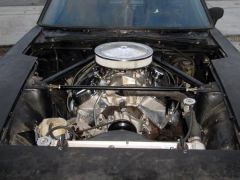
From the album: Big Block Z
-
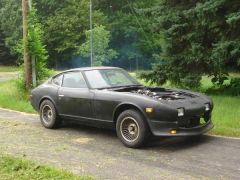
From the album: Big Block Z
-
a few photos of the car and its construction history
-
-
Yes, the key is experience. A person with an extensive record in automotive mechanics could indeed do a mild Z V8 swap without much tribulation or cost. But would such a person need to ask routine questions about parts interchange, fitment, cost, etc.? No. Such people simply show up on Hybridz one day, annoucing their build. For many people here, the Z is their first foray into automotive mechanics, beyond changing brake pads and alternators. But as I posted above, even veteran mechanics can run into serious problems with ostensibly basic builds. Don't disregard the luck factor! And speaking of wiped cams, the Chevy big block is notorious for them. The owner of one of local hot rodding shops, Kammer and Kammer (Huber Heights, Ohio) freely admits that he has suffered cam lobe wipes in customers' cars far too regularly. He is far from inexperienced, and every such mistake costs him financially.
-
"I don't really see where you could run into a "costly dead end" with a carb'd v8 swap" Here's how.... - get a running engine from a junked vehicle. Decide that because it came from a truck, it would be a wise move to swap the cam (mild hydraulic flat-tappet). I mean, who wouldn't change the cam when swapping an engine from a 70's truck??? Do the swap, break in the cam... and promptly wipe it. - tear down the engine and find metal shavings all over the place, from the wiped cam and lifter lobes. - do a complete rebuild. Home-port the heads. Porting job goes well. Take it to a local shop with a flow bench. Flow bench test shows decent results. Take heads to machine shop for pressing-in new valve guides. Machine shop promptly cracks the heads. - buy new aftermarket aluminum heads. Might as well get a nice custom-ground mechanical roller cam. And an adjustable timing set for said cam. - assemble engine. Runs fine. Remove cam cover for some tuning... and find that the bolts on the adjustable timing set backed out, ate into the aluminum timing cover and sent shavings all over the engine. Rebuild #2? And I know of a fellow on this site - who I consider to be nearly a professional-quality mechanic, with a gorgeous Z - who went through at least THREE rebuilds - all on a fairly basic carbed SBC (OK, mine was a BBC).
-
The biggest cost is not the parts that you installed, but the parts that did not fit, that broke, that would not function well together, that had to be replaced/rebuilt etc. If this were a step-by-step assembly exercise, then costs could be accurately estimated and kept under control. But it's not! It is a RESEARCH PROJECT, even if you follow the JTR plans. Why? Because unless you are a seasoned mechanic, you will frequently run into costly dead ends and will overlook seemingly minor anomalies that cascade into critical failures. Also keep in mind that few swaps have a genuinely stock engine. Add the cost and frustration of building a custom engine to building a custom car. Yes, there are shining examples of superb builds at low cost, but for each of those I would wager that there are five >$10K cars still on jackstands!
-
Part of the purpose of punishment is supposed to be deterring hypothetical criminals for committing future crimes, by beholding the sad fate of those already convicted. Some it’s about prevention, not retribution. This may work to some extent for thing such as stiff DUI penalties, but I don’t think that it will help to clean up the financial world. No matter how Medieval we might get on this guy, the upside potential of fraud and nefarious machinations still outweighs the downside. It’s hard to consistently beat the stock market, and these days even by tracking the stock market it’s hard to beat the returns that one gets from burying one’s money in the back yard and forgetting about “making your money work for youâ€. But people can and do try. Many will attempt to cheat their way to profit, punishment or no punishment. The real financial tragedy in the past 15 years has been the lack of good things in which to invest. I remember griping a few years ago on this board how the local real estate market where I live (Dayton, Ohio) is so stagnant or even declining, while people on the coasts are making a killing just by staying in their dumpy old cottage, let alone by speculating in real estate. I was excoriated for my idly cursing the darkness, instead of getting off my lazy butt and finding real estate opportunities a few states over. That was oh-so-2006! Where is that advice-giver now? He was no fool or gambler; but I’ll wager with no fear of foolishness that he has less money now than he did 10 years ago. If even the wise and the longsuffering systematically suffer misfortunes, how can we not expect greedy charlatans to swoop in to take advantage of the less wise and the less knowledgeable investors? No amount of regulation or stiffening of penalties will fix that.
-
Congrats to all the happy new owners of BMWs! I bought a 1992 325is about 5 years ago; had 110K miles then, and about 190K miles now. Reliability has been moderately good; only major repair was the clutch throwout bearing. However, I have low standards; as minor electrical components and interior trim fail, I just ignore them. These cars make decent highway cruisers, suffering from the usual drawbacks of cars in their teenage years… road noise is getting harsh, air conditioning is wheezy, stereo is failing, clearcoat is flaking off, shocks need to be replaced, and so forth. One gets what one gives. My main complaint on this car is the lack of low-end torque. Long-time HybridZ members know that I’m a lazy and unskilled driver, who would rather cart and whine than strive for self-improvement, and therefore I should probably be driving a diesel pickup with a slushbox…. but that said, on the 1992 325is (before VANOS and all those midrange torque augmentation bits) you really have to whale on the rpms to get the car moving. Handling, however, is almost as good as the hype. My second complaint is the rather mediocre mileage. Even in lazy highway cruising, 25 mpg is about the upper bound. In urban stop-and-go traffic, you’re looking at under 20 mpg. For a 3000 lb car with a rated 189-hp engine, this is poor mileage. Late 1990’s M3s are really coming down in price. The local Craig’s List has a 1999 M3 for $7500. Not having much need for transporting passengers, what would most interest me is the BMW M-coupe – basically the hard-roof version of Mike Kelly’s erstwhile heartthrob. I like their aesthetics and interior layout. But these cars are probably rarer than even M5’s, and carry a hefty premium.