
Michael
-
Posts
828 -
Joined
-
Last visited
-
Days Won
9
Content Type
Profiles
Forums
Blogs
Events
Gallery
Downloads
Store
Everything posted by Michael
-
Returning to the health care issue for a moment… I spent the first “formative†years of my life in the former USSR – socialized medicine in the extreme. For the past 24 years I’ve been an “adopted†American. I vaguely remember getting my shots in a government clinic in Leningrad, back in the 1970’s. And I remember all too well breaking my leg this August, the ensuing operation and my sojourn through the private medical system in the U.S. Observations…. If you are seriously, catastrophically ill, there is no better medical system than in the U.S.! When money is no object, when you need the best doctors and the most high-tech medicine, it’s right here. BUT, if you are basically healthy and require only minor, occasional care – such as vaccinations, tooth fillings and blood pressure medicine, you’re better off under socialized medicine. Why? Because when cost and convenience matter more than quality and sophistication, the socialist system of distribution has an advantage. The additional advantage is that in socialized medicine, doctors are employees – civil servants – and not private businessmen. Taking the profit motive out of medicine will hurt innovation and will lower the quality of high-end treatment, but by decimating the prestige of doctors and the medical profession, it makes medical service a commodity. If you have good health insurance, it’s the best of both worlds – at least, for your immediate purposes (high quality care for low out-of-pocket price). But in the long term, this situation is unstable. If you get a heart attack that requires a $70,000 operation, and your out-of-pocket cost is $400, some one still has to pay. In my one case – getting metal plates to reconnect broken bones in my leg – the quality of care probably would have been the same in either system. It’s a relatively low-tech procedure – it probably hasn’t changed in 50 years. But I actually would have preferred to deal with doctors who were salaried employees, not private businessmen. They would have been less arrogant and more accommodating.
-
I recently bought a Lincoln Weld Pak 100. I have zero experience welding. My original intention was to get a Hobart 135 or 175, but the deal on the Weld Pak 100 was too good to forego (it was a returned item at Home Depot). At this point my plan is to purchase a good, auto-darkening helmet, the appropriate diameter and material wire spool, and to commence my attempts at welding sheet metal. The immediate application of interest is the 280Z hood – which unfortunately is light-gauge, and thus probably challenging. I’ve observed in other threads some skepticism about the suitability of a wire welding (no gas shielding, at least not yet) on light-gauge mild steel. However, these are non-structural parts, and I don’t particularly care about aesthetics (splatter and burned holes are OK – this is not a show car). Am I setting myself up for trouble?
-
Gen II (1970-1982?) Chevrolet Camaro front rotor assemblies (they're one-piece, just like the Z) fit the 280Z spindles. I confirmed this in a junkyard: removed a rotor from a mid-70's Camaro, installed it on a Z, tightened the bearing retainer nut, then backed off slightly. The wheel spins freely and there is no rocking perpendicular to the spindle axis. There are two ambiguities. First, the what to do about the brakes? Obviously you can get aftermarket calipers that fit the Chevy rotors, but how to mount them? This would require some sort of custom adaptor. I highly doubt (but am not sure) that a Chevy caliper or its aftermarket replacements would bolt to the stock Datsun strut casting. The second problem is the bearing grease seal; the fillet radius of the Datsun spindle is actually larger than the Chevy spindle. A proper fit would require a grease seal with an inner race conforming to the Datsun spindle geometry, and an outer surface that fits the Chevy rotor assembly. Somewhere I heard that there are standard dimensions for grease seals - only a half dozen or so, which cover all passenger cars. If that's true, it might not be difficult to find a match. So, I think that if the two problems mentioned above were solved, we'd have a cheap bolt-in solution (junkyard Chevy parts) for both better brakes and more common 5-lug wheel pattern for the front wheels. And probably the Wilwood etc. aftermarket parts would be cheaper for the Chevy components than for Datsun components.
-
tiranglated 4 link solid rear
Michael replied to 5foot2's topic in Brakes, Wheels, Suspension and Chassis
5foot2, The mount locations and bellhousing pattern for the Mark IV BBC are the same as for the Gen I SBC. This makes it possible, in many cases, to swap in the one for the other. As a BBC-Z owner whose car is a perennial garage queen, I would recommend that you build a fairly conventional small-block-powered car first, then worry about structural reinforcement, then worry about rear-end upgrades, and only then consider switching to a big block. Unless, of course, you have extensive experience building big blocks, in which case the cautionary advice is probably misplaced. The consensus on this board is that an R200 differential and stock 280Z rear end components will reliable handle power levels in the 400-hp range, and possibly higher. Variables include tire stickiness, 60'-times, transmission types, etc. Halfshafts are the most common failure item - several vendors on this board offer CV-jointed alternatives, which are often combined with brake upgrades. There are many bolt-in alternatives which would improve rear-end grip and durability, before having to resort to complete suspension surgery. My own car has rather elaborate structural modifications, a 461 cubic inch BBC set 6" further back than the JTR SBC-location (the ultimate limitation is the distributor running into the windshield), a Doug Nash 5-speed gearbox, but completely stock suspension and brakes. Why? Because I plan to phase-in the suspension mods gradually, as the car matures and my needs evolve. The structural reinforcements are insurance for future growth. Bolt-in items can easily be added later. This, I think, justifies postponing the decision to switch from an independent rear suspension to a 4-link. -
Guys, please pardon my ignorance, but this is very confusing - 14 psi turbo boost, $12,000, and 13.5 @ 103 in the quarter mile? With that much boost, and for that much money, it seems to me that one ought to expect just a little bit better acceleration???
-
Karl, Getting a 240Z to be as safe and reliable as a modern car would be a considerable challenge, depending of course on what we mean by “safe and reliableâ€. Equipping the 240Z with airbags, antilock brakes and traction control is out of the question. In that sense, it won’t be as safe as your Saturn. But relatively modest upgrades in brakes and suspension will bring your Z’s handling and stopping ability on par with the average late-model car. With a more generous investment in parts and labor, the Z will stop faster and outcorner the majority of new cars, including many labeled as sports cars. Reliability is in the eye of the beholder. Old parts break more often than new parts. You can’t expect the 240Z to be as trouble-free a cross-country touring car as what we find in the showroom in 2004. On a cold winter day, it won’t start as readily as a new car. On a midnight drive down a country road, a blown fuse taking out the headlights is far more likely than in a new car. The dome light amy stop working for no reason, the heater core may leak and the lock on the rear hatch could jam – all on the same trip. On the other hand, if and when parts do break, they’re easier to fix on a Z. A burnt clutch in the Saturn almost guarantees a trip to a mechanic, and a >$1000 repair bill (this exact thing happened in my mother’s 1995 Saturn SL). A burnt clutch in a Z can be fixed in your garage, at one third the price. I would recommend that you keep driving your Saturn for a few years, but look for a decent 240Z in the meanwhile. What’s wrong with having two cars at once? Tinkering with the Z is far more practical when you have a reliable beater for daily transportation. Start by replacing suspension bushings, bleeding the brakes, replacing front wheel bearings, tuning the carbs. These might not be glamorous items, but they’ll give you valuable experience, improve your driving enjoyment of the Z, and have the side benefit of improving your stature as a mechanic in your father’s eyes. Which improves the odds of an ambitious father-son automotive project down the road, by which time you might be ready to build your own engine, instead of supporting Edelbrock’s profit margin.
-
Datsun327, can you contact the previous owner of your car to ascertain whether the 396 was a small block or a big block? Depending on overbore, a 396 small block is possible, but it would be very unusual. On the other hand, a big block in a Datsun would be even more unusual. BTW the mounting pattern and distance from bellhousing flange to motor mount for the BBC and SBC is identical. The only issue is width (distance between the two mounts) – not sure about that. In any case, where a BBC used to sit, a SBC can easily be adapted to sit, if necessary with spacers. Can you measure the distance between mounting pads in your car? I’ll compare it with mine (set up for big block).
-
The above post is probably the most detailed discussion of 240Z vs. 280Z weight that I’ve seen, but it still leaves open the question: “what is the weight difference between the 240Z tub and the 280Z tub� By that I mean, the “unibody†that remains after literally every bolt and bolt-on part is removed, including all glass, trim, sound deadening, etc. The tub is reputed to weigh around 300 lbs – for a 240Z. A friend and I were able to lift one by hand – it was unpleasantly heavy, but not backbreaking. But does anyone have a more accurate estimate? If the 240Z tub indeed weighs 300 lbs (say), and the 280Z tub is 100 lbs heavier, that’s a 33% difference – definitely significant, with profound implications for increase in stiffness (not to claim that extra weight necessarily means extra stiffness, but presumably the tub weight increased largely because more metal was added in an effort to improve stiffness). The point is that whereas a minor error (say, 20 lbs) in estimate of the tub weight is insignificant in estimating the total weight of the car, it’s definitely significant in trying to compare the unibody structure of the 240 vs. the 280.
-
Much depends on how “cheap†a person really is. Recently I bought a 1992 BMW 325is – nothing special, just a decent used car – for what amounts to a few weeks’ worth of wages. But I’m not driving it – it sits in my garage, while I drive my beater Toyota. The BMW is bone-stock, and not even in all that great of a condition. But being cheap, it’s too nice of a car to use with any regularity, when I have a cheaper car at my disposal. My Z – if and when it ever sees pavement again – will end up costing about $15K up through its current iteration. And it will probably get single-digit gas mileage. Those two factors alone virtually ensure that I won’t drive the car for more than a few hundred miles per year. It’s not that I can’t afford it – but that I’m cheap. We often separate “street car†from “race car†based on creature comforts, ride quality, ease of operation, etc. But the flip side is just pure money! I’d gladly drive a noisy, gutted tube-chassis car on the street, if it weren’t for the cost of fuel and wear and tear on the car. Surely a Z06 or an M3 are “streetable†cars – quiet, comfortable, even relatively efficient. But if I bought one, I’d just park it in my garage. So why not just buy a stock Z, and drive that? Well, I drove a 280Z daily, for a little over a year, through all the challenges of a Midwestern climate – with no heat, let alone A/C. I bought it back when I lived in Los Angeles – for $900 – and drove it clear across the country, when I moved to Ohio. Eventually it died. But after nearly 3 years and 63,000 miles in my 1991 Toyota Corolla, I must admit that the Corolla’s performance is actually superior, especially the acceleration. That, compared with the sordid condition of the Z’s body, renders pointless the argument in favor of having kept on driving the Z. My point: ain’t no way that an old, owner-modified, labor-of-love car is going to be a daily driver, at least for me. It’s guaranteed to be a garage queen, whether it’s a simple 350 V8 swap or an 8-second dragster. So it might as well be the latter.
-
This is probably too conservative for your purposes, but the most straightforward swap would be a 22RE engine, found in 1982-1985 Celicas (the last generation of the RWD Celicas) and 80’s/early 90’s trucks. It’s only a 4-cylinder and definitely not a high-rpm engine, but the torque output is good and it’s 2.4L. First-generation fuel injection, actually pretty logical and straightforward to work on.
-
There was a very similar problem with my car (78 280Z); the camber of the left front tire was different than on the right front. Similarly in the rear. And indeed the gap between the spring perch and the tire rim was different on the left vs. the right. In the rear, asymmetry in camber can also LOOK like asymmetry in tow, when visually trying to follow the shape of the tire in the wheel well; the tire with more negative camber appears to “plunge†more into the fender (tow-in). After chasing some dead ends, such as looking for bent control arms or crash damage in the unibody, I removed the strut assemblies from all four corners. And behold, the included-angle between the spindle axis and the strut housing centerline was off by about 2 degrees on the front-passenger and rear-driver corners! This was obvious after unbolting everything from the front strut assemblies, and standing them side by side on a workbench. So I started a thread on heating and bending the strut housings in a hydraulic press, to bring the spindle angles back into spec – and whether that might crack the castings, or the strut housings, or cause some metal to lose temper. The upshot was – bending a little is OK, but don’t heat it. But the best solution is to find new strut housing assemblies. The following year I scoured junkyards for 280Z strut housings. Many were bent, and the quest seemed doomed Then, last winter Mike Kelly kindly donated a spare set of housings. Standing the front and rear strut assembly pairs side by side, they looked absolutely symmetric. When I installed the front assemblies, my asymmetry problem magically disappeared – the gap between spring perch and tire rim was equal on both sides. Installation in rear wasn’t possible because I couldn’t remove the infamous spindle pin from one of the rear strut assemblies. So the point is, (1) remove the strut housings and measure them, and (2) either get new strut housing assemblies or bend – very carefully – the ones that you have.
-
There’s a slightly out of date (about 3-4 years ago) photo-essay on Pete Paraska’s site (look for “Michael Ol’s big block Zâ€). Some day I’ll post newer pictures; though frankly, not much progress has been made since then.
-
The big block Chevy engine WILL fit in a 70-78Z, but the installation is not simple, and an installation that maintains (or improves) the car’s balance is definitely not simple. The main challenges are vertical clearance (either the hood clearance on ground clearance at the oil pan – your choice) and routing the exhaust over the frame rails. Mounting the engine to the steering crossmember, in the JTR fashion or otherwise, is probably unwise – it should go to mounting points welded to the frame rails. If this is your first swap, it’s certainly worth considering installing that engine in a more traditional car, perhaps a domestic. Meanwhile look for a 240-260-280Z for a swap candidate. When you’ve become comfortable with the tuning and modification of that big block, the idea of fitting it into a Z would be more tractable. I did the big block swap (with extensive professional assistance) and after 4 years, the car is still sitting in my garage.
-
Personally I’d be willing to pay well in excess of $20K for a V8Z that very closely meets my personal tastes and interests, but the price level drops quickly even if the workmanship is spectacular but the character of the car isn’t what I prefer. A couple of beers and I’d gladly pay $40K for a brutal, completely stripped tube-chassis car weighing <2200 lbs, that runs in the 9’s – on 87 octane, without nitrous or turbo/blower/supercharger, with a conventional manual transmission – and (very important for me) that can achieve that time even if shifted at 4000 rpm. Because I’m a hamfisted dweeb who likes to launch at idle and can’t tell apart a dragster from a yard tractor. But if the car meets the above specs, I don’t care if it’s a Z, a Camaro or a Yugo (as long as it’s converted to RWD). And I really wouldn’t care about the paint job, whether the various lights or gauges work, or if there’s rust in the rocker panels. If you have a car like that for sale, the cashier’s check is in the mail. Why? Because by the time I invest in tools, experience and parts to get such a car built, it would have cost well over $40K, at a significantly lower level of performance. And this isn’t the sort of car that Troy Trepanier or So-Cal Speed Shop would build for you, even if you showed up with a suitcase full of $100 bills. On the other hand, I wouldn’t even pay $10K for a nice “well rounded†car with a crate 350, 700R4, pro paint job and cream-puff interior, that runs 13’s but requires 6500 rpm shifts to get there. But some people would snap-up the latter example for double the price, and would value the former example no higher than scrap metal. So, yes, it all depends on finding the right customer.
-
why is there no one best sbc cam?
Michael replied to grumpyvette's topic in Gen I & II Chevy V8 Tech Board
For over a year I’ve been shopping for a “small†mechanical roller cam from my 454. Lift in the 0.600â€-0.640†range and duration around 235-240 degrees. A company called Cam Motion has semi-custom grinds in that range, but none of the big-name manufacturers have a mechanical roller cam that small; the choices are custom grind, or having to go hydraulic. -
Not to hijack this thread, but I have essentially the same problem on a ’92 BMW 325is that I just bought; it has a later-generation Bosch engine management system. Does not stumble/miss when cold. Happens when the car is warm, below 3000 rpm, also at idle. No problem above 3000 rpm. Occasional backfire through exhaust, accompanied by sulfur-like smell. Idle when warm is unstable (hunts between 600 and 1100 rpm). These cars have an individual ignition coil per cylinder (no distributor). Neither timing nor mixture are adjustable.
-
Congrats and THANK YOU to Pete Paraska for his Comments!
Michael replied to Mikelly's topic in Non Tech Board
It amuses me when automobiles are compared to masterpiece paintings, sculptures, etc. The purists say that modifying car XYZ is like “Add[ing] some color to that Picasso [painting]â€. Hmm… I wonder if Picasso painted the exact same painting 500,000 times on an assembly line, inside a factory, using machines to hold the brush and mix the paint. I prefer to think of modifying a car as modifying a $10 poster-print of the Picasso on sale at Wal-Mart. Sure, the poster is a rendition of a great work of art, but it’s just a mass-produced facsimile. Adding color to the poster does nothing to defame Picasso’s original. If the incandescent lamp lighting my room makes the poster’s colors look pale, I’ll go ahead and alter them – because it’s my poster, and my $10. -
Needed ASAP... Line on an LS1 Block...
Michael replied to Mikelly's topic in Gen III & IV Chevy V8Z Tech Board
Do the OEM LSI blocks really go for around $500? That's quite amazing, to me at least. Aftermarket aluminum blocks go for $3500 and up! (that's Gen I SBC; Mark IV BBC, with which I am somewhat more familiar, are even higher - typically much higher). -
Well, to return to the beginning of this thread... Yeah, for some reason most V8 conversions for sale have 3-speed automatic transmissions, and fall into one of two categories: lots of customization with questionable overall effect, or a “just dropped in the engine, hooked it up and got it running†conversion. The former would take lots of effort/money/time to undo the 9†fender flares, sunroof and built-in jacuzzi/wet bar; the latter needs new frame rails and rocker panels. Back when I lived in Los Angeles I’d find a V8 Z for sale in the “Recycler†newspaper at a frequency of one maybe every couple of months. A particularly memorable one was a “Nordskog†(sp?) special, complete with elaborate documentation of its history. Its claim to fame was that it had an emissions system that passed California smog check in the 1980’s, when such swaps were rather rare, especially street-legal ones. Definitely something of historical interest. Well, the thing was in such poor mechanical condition that it had a hard time reaching 25 mph on the residential streets where I test drove it. Which reminds me of the recent “how much will it cost to do a swap†thread on the Chevy forum. I considered buying some one else’s project as a route towards cost savings. But after realizing how much would have to be changed to get the car to fit my personal interests, and how much restoration would be required on all but the priciest swaps, it made more sense to start from scratch. Nevertheless... is Jim Biondo’s Z still for sale? Now that one was a genuine deal!
-
how much would putting a 350 in a 1979 280zx cost me?
Michael replied to a topic in Gen I & II Chevy V8 Tech Board
The guys who do manage the swap for $2000 (that figure strikes me as unbelievably low, but let’s accept it for the sake of the discussion) are veteran mechanics who have owned Datsuns for many years, know what to spot in a used car that’s for sale, know how to distinguish a solid engine from a blown engine 99% of the time, already have all of the tools that they need for the swap, and will fabricate nearly every part needed for the conversion. They’re also lucky; skill and patience alone are NOT sufficient to get the absolute best deals. A more realistic figure for cost, if you already have a “rust-free†car, do nothing to modify the suspension and only replace those components necessary to install and safely fit with the engine – is on the order of $2K PLUS the engine and transmission. A typical car with moderate rust, rotted bushings in the suspension, questionable brakes, inadequate wheels and tires… and an amateur mechanic who still needs to buy tools such as MIG welder, drill press, torque wrench,… figure about $6K, not counting the car. If you make mistakes, such as screw up an engine build and cause internal engine damage – add several thousand dollars for each such mistake. In fact, it’s the big mistakes and the midcourse revisions that really drive up the cost. There are cars on this site that are all-around competent vehicles – attractive, well-built hot rods which run in the high-12’s – and cost the owners $30K+ to build. That’s with the owner doing most of the work. And there are guys who have spent $10K, maybe $20K – whose car STILL doesn’t run, and won’t run for years – never mind paint jobs or functioning air conditioning or any of those frills. Bottom line: if you need to ask “How much?â€, you probably can’t afford it. -
We need to distinguish between (A) “it can be done†and ( “it’s worth doingâ€. A – yes. B – probably not. The 240-280Z has relatively high drag and large positive lift because, perhaps contrary to intuition, it has “sharp edges†(hood lip, headlight scoops, others places) where it shouldn’t and smooth inclined surfaces (rear hatch, rocker panels) where it shouldn’t. So, it’s 0 for 2. Pleasing to the eye does not mean pleasing to the wind! Simple experiments with a scale-model Z reveal extensive regions of flow separation – meaning, high drag. Consider that some hot rods based on Model-T and Model-A Fords are running in the low 200’s at Bonneville. So it can be done. But keep in mind how much modification was required to get there. The record-holding 2+2 260 Z was built to adhere to very stringent class rules. This makes the guy’s achievement all the more impressive. But, relax those rules, and the same car could go much faster. So, again: it can be done. But is it worth it?
-
Is cutting the springs a "no no" around here.
Michael replied to Phyte's topic in Brakes, Wheels, Suspension and Chassis
It is not necessary to “flatten†the springs after a coil is cut – the springs will still sit securely in their perches, because the stock spring perches have enough helix angle to accept the unflattened spring ends. At least, this has been my experience with a 280Z, with one coil cut from each spring. -
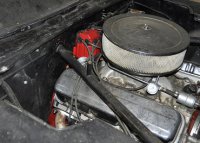
I have a 1978Z with a 454 big block Chevy engine (pictures at link in Pete’s post). The car was built mainly for “street†purposes, but chassis reinforcement and various other mods were so extensive that street driving will be sparse, to say the least. BBC vs. SBC is one of the great debates in grassroots hot rodding. For the same peak hp numbers, the BBC will be more streetable and reliable than the SBC. It will run smoother and stock parts will survive more abuse. But aftermarket parts are much more expensive. For example, the cheapest aftermarket BBC heads begin at $1700 fully assembled, and most are > $2000. In terms of weight, the BBC block weighs about 230 lbs vs. the SBC’s 180 or so. The crank is about 15 lbs more. The big weight difference is in the heads – about 60 pounds. Figure another 30 pounds weight difference in odds and ends. With a cast-iron block but aluminum heads, intake, water pump, flywheel, etc., the BBC will still be around 80-100 lbs heavier than a comparably built SBC. With the advent of large displacement small blocks, 406†and above, I think that the balance has shifted in favor of the SBC for street-driving purposes. And I say that as a BBC owner. A BBC Z is something to build only after you already have a SBC Z under your belt. Keep in mind the two extremes of advice: most guys who haven’t done it are likely to consider it next to impossible. But, those guys who have done it are invariably veteran hot rodders, whose definition of “a little extra work†differs from the mainstream. I am not a veteran hot rodder, so I paid a friend to do the metalwork. In my car, the front clip was cut off, the firewall and floor were cut out, the floor pan was shorted, a mild-steel tube frame was built on a jig and welded into the car. Then the firewall/floor were welded back in, then the front clip, then the missing segments of frame rails and sheet metal were reconstructed. The transmission tunnel was reworked to fit a Doug Nash 5-speed, the steering linkage was reworked to accommodate the firewall setback, the seats mount to the roll cage, the dash is gone because it conflicts with the cage’s dash bar, the radiator mounting is completely redone, and so forth and so on. The engine is so far back that the distributor sits just 2†forward of the windshield – and the car is still 51/49 (nose-heavy), but that’s with cast iron heads. Because it was completely gutted, the car weights about 150 lbs less than stock. With a stock suspension (one spring coil cut at each corner, plus the JTR bumpsteer mod – otherwise completely stock suspension), the car sits higher than stock. No, you don’t need such extensive mods to swap in a big block, and if you already have a complete engine lying around, the extra costs of a big block are moot. I started from scratch, and in my view it only made sense to build a blood-and-guts race car if I were to go to the trouble of swapping in a big block. In terms of just getting the BBC to fit where a SBC already fits, it really isn’t that much extra work. The extra work is in making refinements to the car commensurate with the theme of a big block. Talk about the “while I’m at it†syndrome in the extreme. As for hood clearance – with a high-rise dual-plane intake manifold (such as Edelbrock Performer RPM) and the stock 9â€-deep oil sump, either the sump will hang well below the frame rails or the air cleaner will hit the hood. My hood had a hole in it, with the air cleaners sticking through. Later I covered the hole with sheet metal and fiberglass. Anyway, to summarize my views as a BBC Z owner: considering the costs, the extra fabrication, the aftermarket support for small blocks and the various challenges involved, I would recommend tackling the big block swap only if you have extensive hot rodding experience. E-mail me at ol_70@hotmail.com for more details.
-
Mike, Is this another "here we go again" again? I thought that you decided, once and for all, to hold on to that Z - especially after the engine came back together?!
-
This was asked before (I vaguely recall reading the post), but I couldn't find it - so, to ask again... How long can an assembled short block be stored on an engine stand, before the assembly lube leaks out from the bearing journals, necessitating tearing into the rebuild? After a month on the engine stand, I noticed some leakage from the crank main bearings. I was wondering how many more months I could safely wait, before full assembly and break-in.