
NewZed
-
Posts
6702 -
Joined
-
Last visited
-
Days Won
72
Content Type
Profiles
Forums
Blogs
Events
Gallery
Downloads
Store
Everything posted by NewZed
-
This web site is pretty informative. It shows that they're all the same until July-August of 1976 build date. http://www.carpartsmanual.com/datsuns30/DatsunZIndex/Brake/RearBrake/tabid/1734/Default.aspx
-
No need for the part number. Just pointing out that JWT Z31 ECU could be one of many possibilities. Even 84 turbo has four model numbers. Also implying that there is no guarantee that the PO knew what he was doing. People install large injectors all the time thinking that more gas = more power. And there's no way to notice no info on the JWT site for your older ECU because it was never said that it was an older out-dated ECU. It's not apparent that you've been on the site, or actually talked to someone at JWT, you didn't say. It looks like you have more information than you've shared. Post it up. Not many people talk about the JWT products, they're a mystery even though they've been around for a while.. The O2 sensor is only really in play during cruising conditions. Probably not the cause of your flames.

-
Maybe the PO installed super-duper 440 cc Supra injectors to go with the JWT modified ECU. Lots of different ECU's under the "JWT Z31" category. A lit of part numbers will help you out in the long run. Know what you're working with. http://www.jimwolftechnology.com/customer_results.asp Here's something useful - http://jimwolftechnology.com/wolfpdf/280%20Z31%20450HP%20UPGRADE.PDF
-
Your new injectors have a different, newer style of nozzle. I've seen it on a few other brands, like BWD and Standard (yours are probably one of those brands). Your new injectors aren't designed to use a pintle cap. The tender pieces are recessed inside the injector tip, protected. As far as directions on what to do when increasing injector flow, those would be in your SDS instructions. Lower injector open times would be the main change.
-
Advice needed with 240z ignition
NewZed replied to chrisdavid1130's topic in Ignition and Electrical
IF you're just looking for stronger spark the MSD can be run from your 1973 points distributor. If you're looking for more adjustability in your advance curves the Mallory might offer that. The simplest, cheapest way to get stronger spark might be a 280ZX distributor with its electronic module. You can get them for about $125 from Rockauto or your local parts store. Not shiny and don't have a big brand name attached but pretty effective. Don't forget that a new distributor will come with different centrifugal and vacuum advance curves. The curves have a big effect on driveability and power. -
I thought JMortensen would be pretty good at evaluating quality. He's been deep in to the details on his other car. Good luck.
-
How did you miss this one - http://forums.hybridz.org/topic/118434-1970-rolling-chassis-suprisingly-light-rust/?do=findComment&comment=1110416
-
Don't know if this will help, but I measured voltage on the four pins to my 1995 Pathfinder CAS, with it disconnected from the distributor and key On, and I get one ground wire (zero), one 12 volt, and two 5 volt. The Pathfinder has the same type of optical CAS with a high resolution and low resolution trigger out. So the 5 comes from the ECU. The "trigger" might just be the phototransistor grounding the circuit. I think that much of what is written about the "trigger" voltage coming from the distributor may be mis-guided or wrong.
-
You're not comprehending...
-
The fuel pump is not supposed to stay on unless the engine is running. On early cars nothing happens until you hit Start. Later cars had a priming function controlled by relays and/or the ECU. You need to know what is controlling your fuel pump power.
-
The Factory Service Manual (FSM). You can open the relevant chapters here - http://www.nicoclub.com/datsun-service-manuals
-
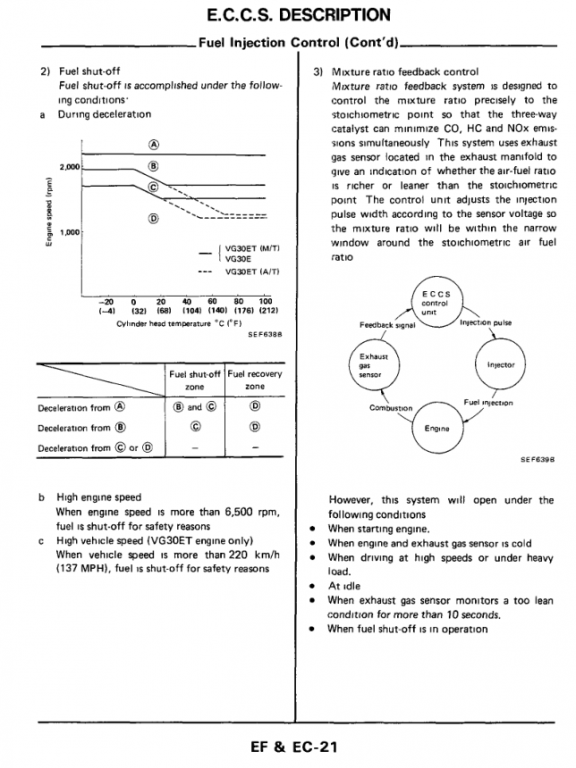
Pages 1982 EL-32 and 1982 EFEC-96 should help you out. It will take more effort than typing out "because" though. Probably hard to see on your phone also. A volt/ohm meter at the ECCS plug and those two pages should be enough. Good luck.
-
On the New Content page, on the left, do you have Forums chosen? Might have blogs or some other odd thing. If I choose Blogs or Downloads or Calendar, I get no content.
-
I just clicked it and got three pages of New Content. Windows 7 with Google Chrome browser.
-
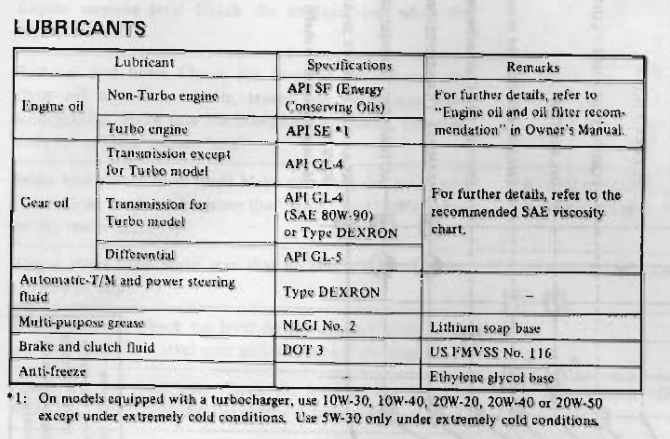
Actually that's not clear from the Nissan service specs., and that's where the confusion comes from. Plus the fact that some BW manual transmissions specify Dexron, according to the interweb. See attachment for Nissan spec. Notice that Nissan calls out the automatic transmission specifically right below the manual transmission spec. It's just a poorly written specification. Here's a pretty good summary that throws in the confusing point with no clarification. World class versus non world class, but who knows if that's true. Nissan calls out either fluid in their spec. Maybe Nissan used both WC and NWC in their turbo cars and the owner is supposed to know which they have. It's a mess. About paragraph 7 - http://www.hemmings.com/mus/stories/2007/05/01/hmn_feature21.html
-
So I heard these cars are rated to 27mpg highway?
NewZed replied to osirus9's topic in S30 Series - 240z, 260z, 280z
This is one of those threads that could ramble around for weeks, but just for curiosity what is unknown about the injectors? Do you have a part number? Are they the stock injectors for the engine you're using? Turbo injectors? Or truly unknown? If you have the wrong injectors for the EFI system you're wasting money buying Seafoam. -
So I heard these cars are rated to 27mpg highway?
NewZed replied to osirus9's topic in S30 Series - 240z, 260z, 280z
How do you calculate mpg from 100 miles? Now seems like the right time - http://www.mycyclonefuelsaver.com/howitworks.html -
Last post - I think that the 5 that's measured with the factory system comes from the ECU. You have a 12 volt supply on your pullup line so should be seeing 0 or 12, I believe. The 5 volts that you're seeing might be a coincidence. The voltage is not generated from within the distributor, it's just allowed through. The 5 and 4.75 you're seeing might just be the result of a voltage drop (from 12) from a short somewhere. Another guess. Sorry to clutter up your thread.
-
You've probably seen this or something like it. Zero or five seems like the right numbers. http://my.cardone.com/techdocs/PT%2031-0002.pdf Edit - note that the test is with everything plugged in.
-
Might as well post this for photo-diodes. It seems like the Nissan system would just put out a voltage, with only power and ground. Maybe it's between tach wire and distributor body. Almost the bottom of the page, Optical Triggering. Don't forget that MS is set up with VR trigger even with an optical distributor. http://www.megamanual.com/ms2/pickups.htm Good luck.
-
What happens to resistance on the tach line with power and ground connected to the distributor, but nothing on the tach line. If it's a switch like the HEI module it will go from low to high. The FSM says it's a pulse,which may or may not be a voltage. Maybe you just need a bigger pullup resistor. More guesses. At the bottom of Moby's writeup he says that a 2K resistor is for 12 volts and the 1K is for 5 volts. From the writeup: ____________________________________________________________ *Pullup/Pulldown resistor quick course You use a pullup resistor to get your line(or pin,connection) to some voltage (5,12, etc). Suppose you want a pin to have 5volts. If you just add a wire to 5 volts there is nothing to limit the current and if the pin happens to be an input to a transistor that is switched to ground then you have a short to ground from 5 volts and you burn stuff up. So instead you add a resistor to the 5 volts and the resistor will limit the current according to ohms law. Current is voltage divided by resistance. If you put a 1k ohm resistor to 5 volts then if the pin is switch to ground by internal electronics it can only draw 5 milliamps max(the resistor current-limits the path). A pulldown is similar except that you want a pin/wire connected to ground and you want the path to be current limited. To size the pullup or pulldown correctly you should know what the circuit is that you are adding the resistor to. But as a general rule you can use a 1k resistor for 5volts and a 2k resistor for 12volts. That limits the current to a few milliamps which is conservative. Sometimes the circuit may require more current to operate properly.
-
What happens if you just measure voltage at the tach signal to ground, with power and ground to the main distributor wires? I'm just curious as to how the tach is designed to work. The FSM implies that it outputs a voltage on the two output wires, zero or something (1982 EFEC-61). I think that the pullup resistor might be for the Megasquirt side, not the distributor side. Maybe. I thought I understood the pullup resistor for the HEI module because it pulls up one circuit (G and W) so that it can control the other (B and C). Normally G and W would have negative and positive voltage from the VR pickup. I don't get the purpose for the distributor tach line, since the "control" is from the other side. Unless it's completing a circuit to ground through the tach line and somewhere, like the distributor body. Just thinking in writing. Is your distributor body well-grounded? Maybe you're missing a ground circuit somewhere. Don't place too much value in any of this. Basically, I'm just bumping your thread until someone who knows speaks up.
-
Edit - I don't know enough about electronics to guess anymore. I would certainly try to isolate the distributor from the other components though. Don't test with everything connected together. Interesting problem. Good luck.
-
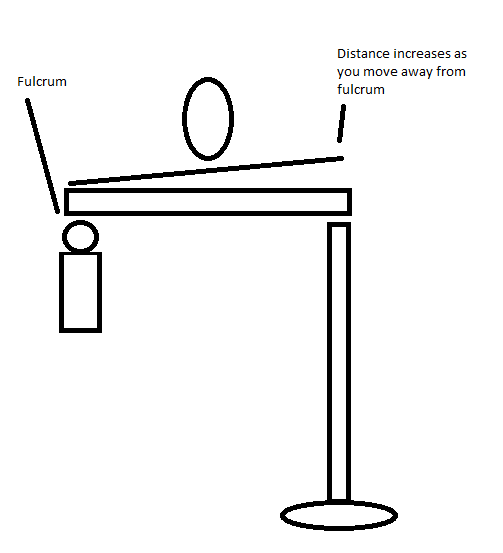
It's easy to mis-visualize the parts.
-
The simplest test for you would be to view fuel pressure when the problem happens. Get the vacuum number from your dash gauge and the fuel pressure number from another and you'll have numbers that tell you something. The standard practice is to T in a service gauge and run the hose out of the partially open hood to where you can see it while driving. Your idle numbers don't show anything wrong. But, more to the point - does the engine run differently above 4000 RPM? You never really said. Or are you doing all of this work because your AEM gauge shows a number? You might just have an exhaust leak.